
Emergency Air Duct Cleaning Near Me: What Draper Homeowners Should Do First
If you’ve just found sewage backing up near your air handler, or you’ve spotted droppings in a return box, calling an air duct company first is the wrong move. Most “emergencies” that send Draper homeowners searching for same-day duct cleaning aren’t duct problems at all. They’re HVAC events – a flooded air handler, smoke intrusion, rodents in the return – where the ductwork is a secondary concern. Any company that shows up without asking what caused the contamination is about to clean a system that re-contaminates within days.
If you’d rather have a trained set of eyes on it instead of guessing, call (855) 550-7165. We answer 24/7. Fast dispatch from 7am to 7pm, Sunday through Friday.
Which Duct Situations Are Real Emergencies in Draper?
A real duct emergency is one where contamination is actively entering your living space and will keep doing so until the source is stopped. In our experience across Draper, four situations actually qualify:
- Smoke or fire residue. After even a small kitchen or electrical fire, soot particles lodge in duct lining and get pushed back into rooms every time the blower runs. This is a health and odor issue that doesn’t resolve on its own.
- Sewage aerosol intrusion. A sewer backup near the air handler or a cracked drain line under a slab can aerosolize bacteria that the blower then distributes through the whole house. This is the one people most often misdiagnose as “just a smell.”
- Post-flood mold risk. Water in the plenum or wet duct insulation starts growing mold in a matter of days, not weeks. If your HVAC system pulled in floodwater, the clock is running.
- Rodent nesting in the return. Mice and rats shred filter media and insulation to nest, leaving droppings and urine that circulate with the air. It’s a genuine contamination problem, not just an unpleasant discovery.
Everything else – a dusty register, a musty smell in one room, dirty grilles – feels urgent but can wait for a scheduled appointment. Distinguishing between the two is the whole game.
What Should You Do in the First 30 Minutes?
Shut the system down. That single step matters more than getting a crew to your driveway fast. With the HVAC off, you stop distributing whatever’s in the ductwork into every room of your Draper home. Then work through a short, specific sequence depending on what you’re facing.
- Turn off the HVAC at the thermostat and the breaker. Don’t rely on the thermostat alone if you suspect water near the unit; kill power at the panel.
- Document before you touch anything. Photos of the water line, the droppings, the soot pattern, or the sewage backup are the single most useful thing you can hand a technician or your insurer. Do this before cleanup.
- Isolate the affected area. Close registers in the contaminated zone if the system must run for any reason, and keep pets and kids out of the area around the air handler.
- Find the source. A wet air handler means water is still entering; a rodent issue means there’s an open penetration somewhere. The ducts can’t be fixed until that path is closed.
- Call with the details, not just the address. Tell whoever answers what happened and where. That’s how you get routed correctly instead of getting a generic cleaning visit.
None of that requires touching a spring, a wire, or a gas line. The dangerous work belongs to trained technicians, and so does the duct cleaning itself.
Why Does Cleaning Before Containment Fail?
Because contamination has a source, and if that source is still active, your freshly cleaned ducts are a temporary condition. We’ve seen this pattern often enough that it shapes how we scope every emergency job. A duct system is a closed loop: air leaves the supply registers, returns through the return ducts, passes the air handler, and repeats. If the return is pulling air from a crawl space with rodent activity, or the air handler sits in standing water, or smoke damage hasn’t been sealed, cleaning just resets the clock.
Containment first means identifying and shutting off the entry point – sealing a penetration, drying the plenum, treating the actual water source. Only then does duct cleaning make sense. This is why we treat air duct cleaning as the middle step in a sequence, not the whole answer. Clean, then repair and seal, then sanitize. Skipping straight to the vacuum is how a company bills twice for the same problem.
If your contamination traces back to wet or damaged duct runs, our air duct cleaning work is paired with HVAC cleaning so the air handler and coil aren’t left holding the same debris the ducts just released.
What Does a Legitimate Emergency Response Look Like?
A real emergency job has a recognizable technical signature, and you can watch for it when the technician arrives at your Draper home. It starts with an inspection before any equipment runs, because a technician who doesn’t know what’s in the system can’t contain it. From there, a proper response follows a clear pattern:
- HEPA containment. The work area gets sealed off and the system is placed under negative pressure so debris doesn’t escape into living space while it’s being removed.
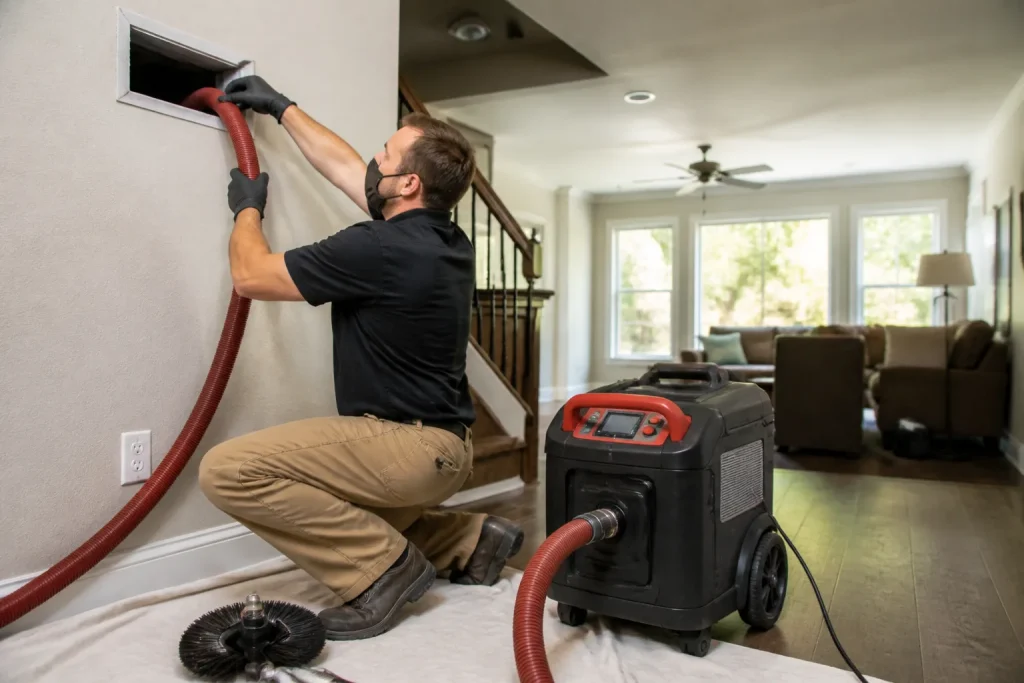
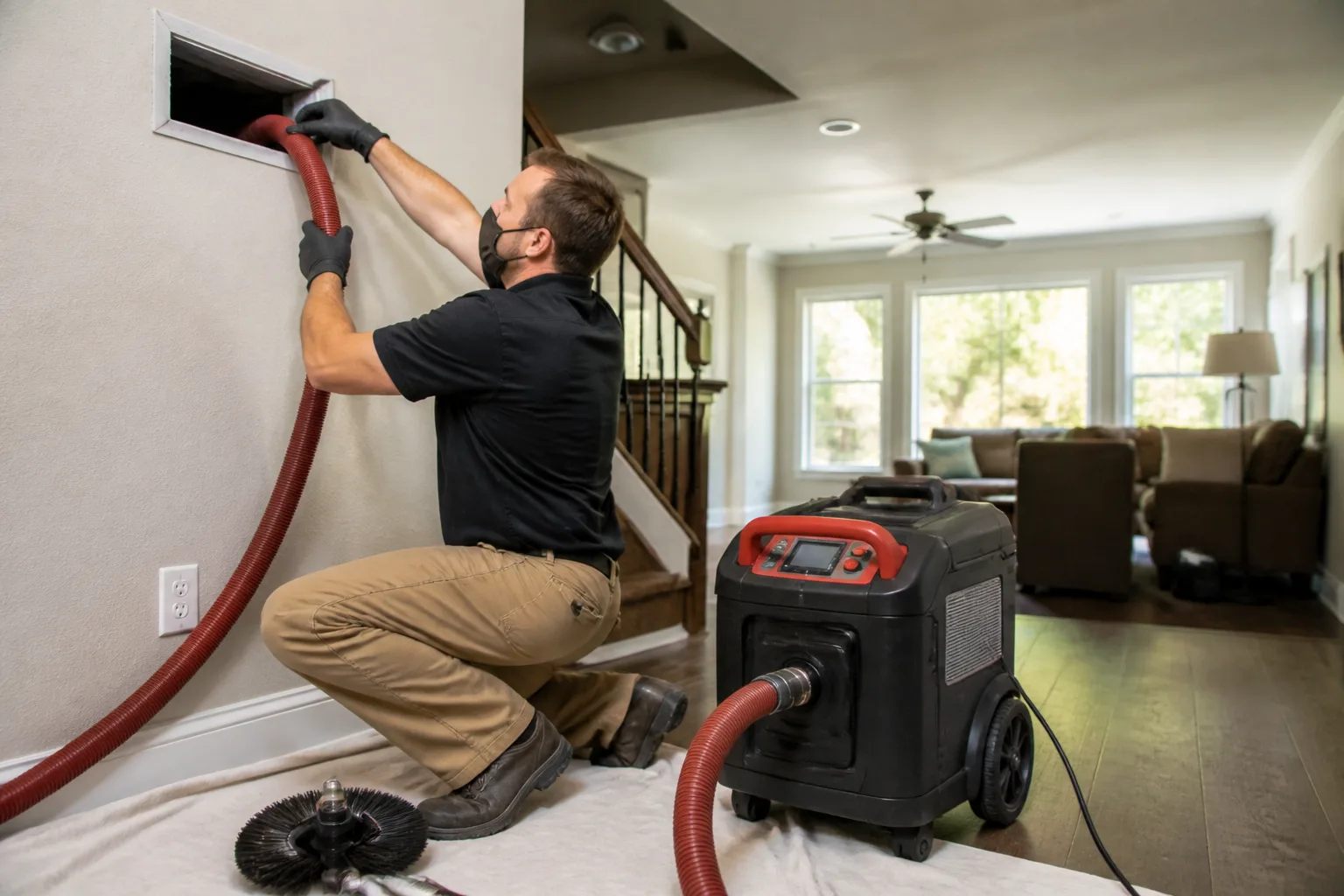
- Source-correct equipment. Professional duct cleaning uses purpose-built machines – we run Rotobrush and Nikro systems, which are designed for this job rather than adapted from shop vacuums.
- Verification after cleaning. The technician should show you what came out and confirm the system is clean before sanitizing.
- Sanitizing with an explained agent. Air quality treatment is where the source-level work happens, and we use Abatement Technologies equipment for exactly this. A legitimate tech can tell you what the agent is, what it targets, and why it’s appropriate for your situation.
That last point matters. If a company can’t explain what they’re spraying into your ducts, that’s your cue to ask harder questions.
Red Flags When You Call for Emergency Duct Cleaning in Draper
The right company asks questions before it quotes. In an emergency, the wrong company is easy to spot if you know what to watch for. These are the patterns we’d want a Draper neighbor to catch:
- They show up without inspecting. A technician who starts the vacuum before looking at the source has already skipped the step that determines whether the job will hold.
- They skip containment setup. No negative pressure, no sealing, no drop cloths – debris goes straight into your air.
- They can’t explain their sanitizing agent. Vague answers about “a special treatment” aren’t good enough. You’re entitled to know what’s going in your home.
- They pressure you into a same-visit add-on. Dryer vent cleaning and air quality treatment are legitimate services, but they should be discussed on their own merits, not as a scare tactic in your hallway.
One flag deserves its own mention. dryer vent cleaning is a genuine safety service – a lint-clogged exhaust is a real fire hazard, not a maintenance footnote – but don’t let anyone sell it as the reason your ducts are “dangerous.” They’re separate systems and separate conversations.
When Should You Call a Pro, and When Can It Wait?
Call a pro now if any of the following is true: you’ve had fire or smoke in the home, sewage has reached the air handler or ductwork, water is standing near the HVAC unit, you’ve found rodents or their droppings in the return, or you’re seeing visible mold growth inside a register or on duct lining. Those are situations where the source needs to be addressed first and the duct system cleaned correctly afterward.
Wait for a scheduled appointment if the issue is a gradual musty smell, visible dust buildup, or a dirty filter you haven’t gotten around to replacing. Those aren’t emergencies and paying an emergency premium – or getting rushed work – won’t serve you. What you want in a Draper home is a clean, sealed, and sanitized system, and that’s planned work as much as it’s reactive work.
For related work in Draper, we also handle air quality and sanitizing for homeowners who want the source-level treatment after cleaning, and whole-home filtration systems from Honeywell and Aprilaire that keep the results lasting.
How Much Does Emergency Air Duct Cleaning Cost in Draper?
Pricing is set per job by the written estimate, and the estimate is free. In our experience, homeowners in the Draper market typically see whole-system duct cleaning land somewhere in the $300 to $800 range depending on the size of the home, the number of runs, and how much contamination is involved. Sanitizing is usually priced as its own line item on top of cleaning, and emergency-scope work involving smoke, water, or sewage tends to run higher because containment and verification are part of the job, not extras.
- Standard whole-system duct cleaning (estimated): roughly $300 to $800
- Sanitizing or air quality treatment (estimated): priced per job, quoted separately
- HVAC cleaning of the air handler and coil: included in scope review, quoted with the system
- Dryer vent cleaning (safety service): quoted per run, separate from duct cleaning
The written estimate is what sets the final price, so the number you agree to is the number you pay. Any company quoting an emergency price before inspecting the source isn’t quoting you, they’re guessing. Call (855) 550-7165 for an exact quote – estimates are free.
Why Is the Source the Whole Story?
Because the duct system doesn’t create contamination. It moves it. A flooded air handler, an active sewer leak, a rodent penetration – each of those is a source, and each one has to be closed before cleaning can hold. If you’re searching “emergency air duct cleaning near me” in Draper right now, the most useful thing you can do is identify what happened and shut your system down. Everything else gets easier from there. Our technicians have up to 12 years of experience with exactly this sequence, and we’d rather ask you the right questions than rush a clean that won’t last.
The Bottom Line
Real duct emergencies in Draper are caused by something else – fire, water, sewage, rodents – and the ducts are the messenger. Shut off the HVAC, document the source, isolate the affected area, then call. Any company that skips the inspection, skips containment, or can’t explain its sanitizing agent is one to walk away from. Clean, sealed, and sanitized is the correct order, and it starts with the source.
If you’re in Draper and need help, Draper Air Duct Cleaning Pros offers free estimates – call (855) 550-7165. We answer 24/7. Fast dispatch from 7am to 7pm, Sunday through Friday.
Frequently Asked Questions
Yes, if the air handler or duct insulation took on water, because mold can begin growing in a matter of days and the blower will spread spores through the house. Shut the system off, dry the source, then get the ducts inspected and cleaned. Call (855) 550-7165 for a free estimate – we’ll help you sequence it correctly.
No. Running the system pushes whatever is in the ductwork into every room. If the contamination source is active, you’re just spreading it further. Shut the thermostat and breaker off first, then call (855) 550-7165 for an exact quote – estimates are free.
A legitimate technician shows you what came out, sets up containment so you can see it, and explains the sanitizing agent before applying it. Ask for photos of the before and after. If those requests make the company uncomfortable, that tells you something. Call (855) 550-7165 – we’re happy to walk you through the process first.
For most homes, every few years is reasonable, and sooner after any fire, flood, sewage event, or rodent intrusion. Homes with pets or recent remodeling tend to need it more often. Call (855) 550-7165 for a free estimate based on your actual system.
Written by the team at Draper Air Duct Cleaning Pros.
Need Air Duct Cleaning Help?
Call Draper Air Duct Cleaning Pros - the local pro we connect you with is licensed and insured, here with fast help in Draper.
(855) 550-7165