
Top Signs You Need Air Duct Cleaning Service – Don’t Ignore These
Dust on your vent covers is almost never a sign your ducts need cleaning. Usually it’s a filter that’s undersized for the return, or grilles that just need a wipe. The signs that actually point to duct contamination are subtler: odor that follows the airflow, particulate discharging at a register, one room that always feels different from the rest. Knowing which symptom belongs to which problem is the whole game. If you’d rather not sort it out yourself, call (855) 550-7165 and we’ll talk it through.
Here’s the diagnostic framework we use, written out so you can run it in your own house.
Two Different Problems Get Called the Same Thing
Most “signs you need air duct cleaning” lists blend two unrelated failures into one. That’s why so many homeowners pay for a cleaning that doesn’t fix anything, or skip one that would have. In our experience running calls around Draper, the split matters more than any single symptom.
Duct contamination signs are about what’s inside the ductwork and moving into your rooms:
- Odor that appears only when the system runs, and intensifies in the rooms closest to the affected trunk
- Visible dust or particulate puffing out of a supply register when the blower starts
- Room-to-room inconsistency in air quality: the bedroom smells stale, the hallway doesn’t
- Dark streaking around register frames that reappears after cleaning
- Debris visible on the duct floor when you look past the register boot
HVAC maintenance signs are about the equipment moving the air, not the ducts themselves:
- Reduced airflow at every register at once, which usually means a blower, filter, or coil problem
- Frost on the evaporator coil or refrigerant lines
- Energy bills climbing with no change in usage
- Short cycling or a system that runs constantly without satisfying the thermostat
If most of your symptoms land in the second list, a duct cleaning won’t solve them. Cleaning out a duct system attached to a struggling blower just moves the problem around. Our HVAC cleaning work addresses the equipment side, and sometimes the right first step is diagnosing there before anyone touches the ducts.
How to Self-Inspect Before You Call Anyone
You can evaluate a good share of this yourself with a screwdriver and a flashlight. Ten minutes, no special tools.
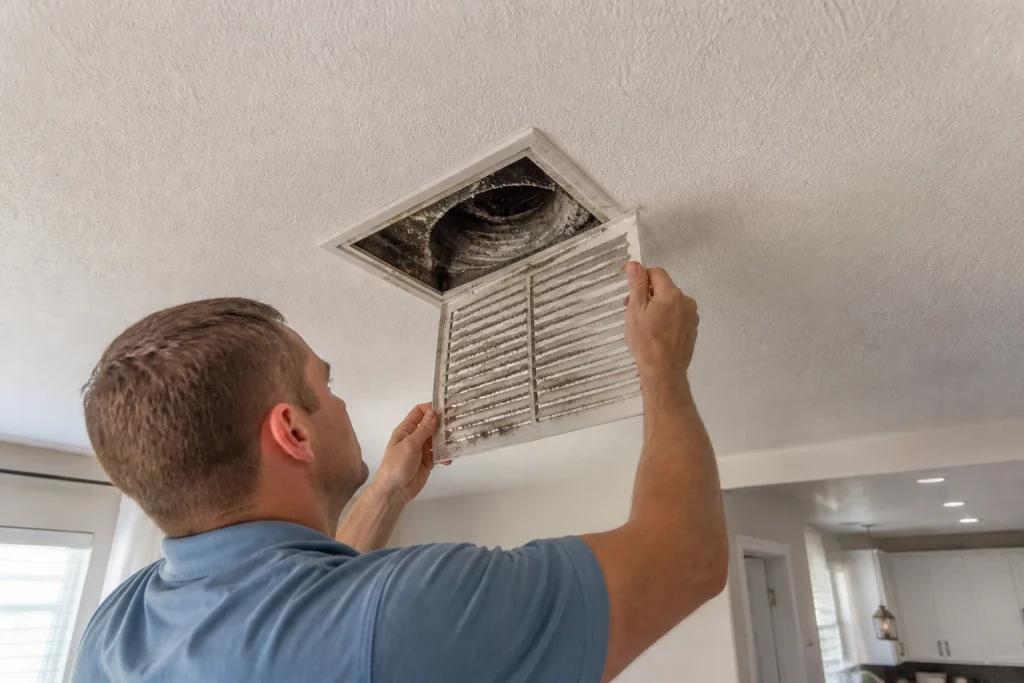
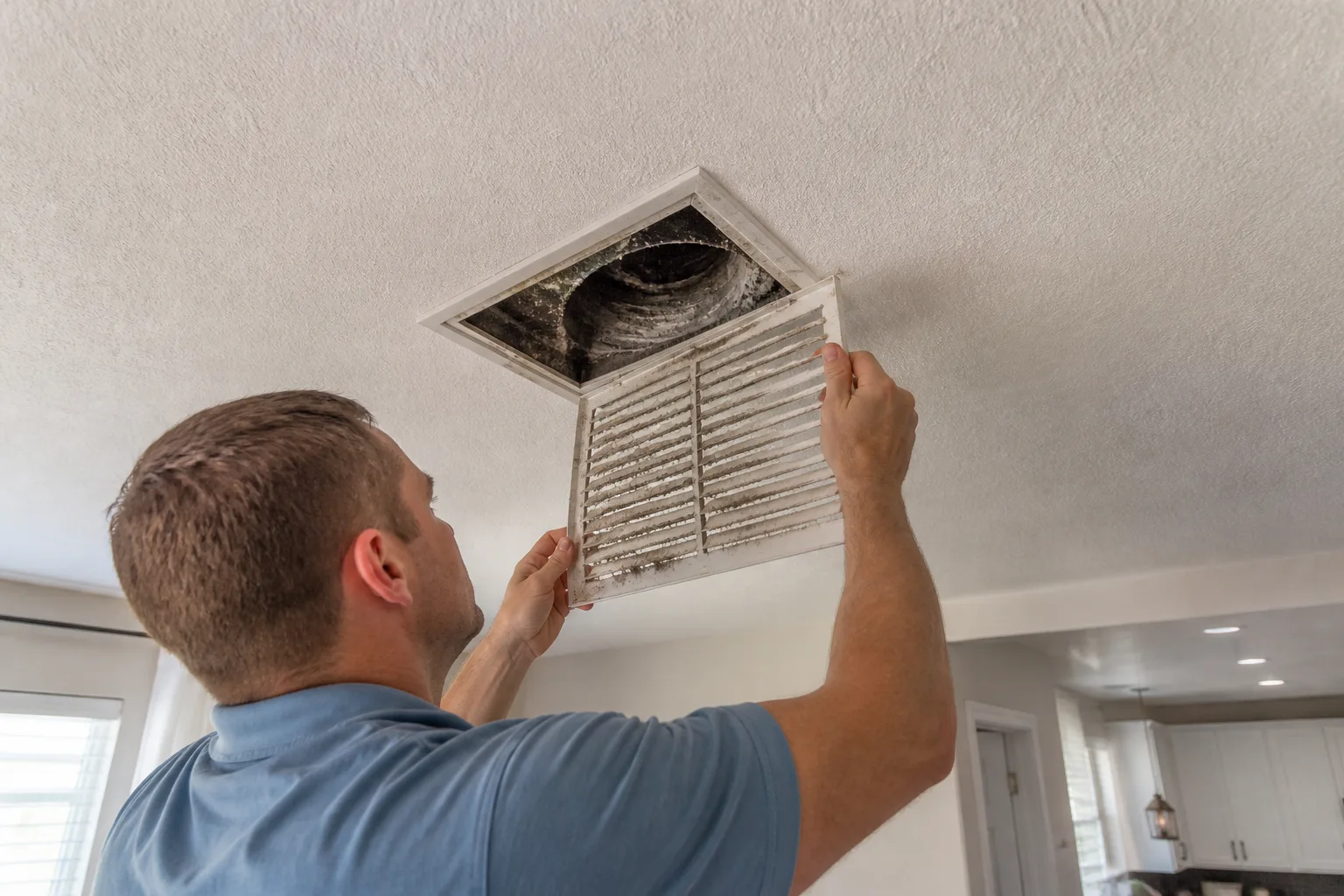
- Pop one supply register. Take out the screws, set the grille aside, and look down the boot into the duct.
- Shine the flashlight down the run. You’re looking at the duct floor, not the walls. Gravity decides where debris collects.
- Note what you see. A thin film of dust is normal on any system that’s been running for years. Visible accumulation, clumps, fibers, or anything that looks like it has a texture is worth flagging.
- Wipe the inside of the boot. A white paper towel pressed against the metal tells you fast whether you’re getting loose dust or something greasy and dark.
- Repeat at a return. Returns carry far more volume than supplies, so they’re the more honest read on a system in Draper. Compare the two spots.
- Watch a register for a minute after the blower kicks on. Particulate you can see drifting out is a genuine signal; a fresh dust scent that fades in seconds usually isn’t.
What you’re building is a picture, not a verdict. One grubby boot doesn’t justify a full cleaning. A pattern across several registers, particularly at the returns, is a different story. If the flashlight shows something you can’t identify, photograph it and have it looked at rather than guessing.
Why Draper Homes Push Ducts Harder Than the Generic Advice Suggests
The standard recommendation is to clean every three to five years. That’s a guideline, and around Draper it needs adjusting in both directions. Three local conditions change the math.
High-desert dust. This valley’s air carries fine particulate much of the year. A system pulling that in through the returns filters most of it, but the fraction that gets past a marginal filter accumulates faster than it would in a wetter climate. Homes here tend to see the inside of a duct run soil sooner.
Wildfire smoke seasons. When smoke settles over the valley for days at a stretch, the system runs more with the house closed up, and fine smoke particulate rides the return air. A duct system that was acceptable in spring looks different after a bad August.
New-construction drywall dust. This is the one most people miss entirely. In a newly built Draper home, drywall dust and construction debris settle into ductwork during build-out, sometimes before the registers are even sealed. A house that’s a year old can have more in its ducts than one that’s fifteen. If you’ve recently finished a basement or a remodel, that timeline compresses to right now.
Run the variables against your own house: pets, recent construction, smoking indoors, a filter you’ve been meaning to change. Any two of those together and the three-to-five-year guideline stops being useful. It’s a starting point, not a rule.
When the Problem Is Bigger Than Cleaning
Some findings mean a cleaning alone won’t hold. If you see any of the following, the fix is a repair or a treatment, not another pass with a vacuum.
- Visible mold growth inside the ductwork or on the insulation liner. Mold needs moisture, so the source has to be found and corrected, not just wiped. This is where sanitizing treatment earns its place, targeting spores and bacteria at the source rather than stirring debris around.
- Insulation debris in the airstream. Deteriorating internal duct liner means fiberglass particles are being delivered into your rooms. Cleaning won’t repair a failing liner.
- Animal intrusion evidence. Droppings, nesting material, or a chewed entry point means there’s an opening to close before any cleaning is worth doing.
- Loose or disconnected joints. Ducts that have pulled apart at a seam leak conditioned air into the attic or crawlspace. Cleaning a leaking system wastes effort; sealing it is the fix.
This is why our work extends past cleaning into duct repair and sealing. Sealing the leaks closes the loop so energy isn’t wasted and contaminants aren’t reintroduced the day after a cleaning. A lot of duct cleaners skip that step entirely, and it’s the step that decides whether the cleaning lasts. For a system that’s both dirty and leaking, the sequencing matters: repair first where needed, then clean, then seal. The systems we use, Rotobrush and Nikro equipment built specifically for duct interiors, handle the cleaning pass without tearing up what’s already in place.
A Related Risk That Isn’t Your Ducts at All
One safety point deserves its own section because it gets filed as an upsell when it’s anything but. Your dryer vent is a fire risk, not a maintenance footnote.
A clogged dryer exhaust traps heat and lint together. Lint is highly combustible, and the vent is the one path that heat has to escape. Signs to watch for: clothes taking two cycles to dry, the dryer body feeling hot to the touch, a burning smell during a cycle, or lint visible at the exterior vent flap. If you notice any of these, stop running the dryer until it’s checked.
Dryer vent cleaning is a standalone service for us, handled by technicians trained on exactly that hazard, rather than something tacked onto a duct job. It’s worth scheduling on its own timeline regardless of what your ducts need. That’s part of our dryer vent cleaning work, and it’s the service we’d most like every Draper homeowner to think about before they think about anything else on this page.
When to Call a Pro
Call when the self-inspection turns up accumulation you can see without straining, when an odor follows the airflow through the house, when you’ve found mold or insulation debris, or when a remodel has just wrapped. Call sooner if you smell burning near the dryer. Those are the cases where guessing costs more than a look. The technicians we connect you with have up to 12 years of experience, and the local pro is licensed and insured as their state requires.
Related services in Draper: if your inspection points to the ducts themselves, our air duct cleaning service covers the full system, and our team at Draper Air Duct Cleaning Pros handles cleaning, repair, sealing, and sanitizing under one call, so you’re not coordinating three contractors for one indoor-air problem.
The Bottom Line
The signs that genuinely call for duct cleaning are specific: odor that tracks the airflow, visible particulate at a register, uneven air quality room to room. Airflow problems and high bills usually point at the equipment instead. The three-to-five-year guideline is a starting point, and in Draper, high-desert dust, smoke season, and construction dust all shorten it. Look past a register with a flashlight before you call anyone; the answer is often right there. If you’re in Draper and need help, Draper Air Duct Cleaning Pros offers free estimates – call (855) 550-7165.
Frequently Asked Questions
Look past a supply register into the duct floor with a flashlight. Visible accumulation, clumps, or fibrous material means it’s worth a professional look. Odor that follows the airflow and particulate you can see discharging at a register are the two strongest indicators. A thin film of dust on the duct walls alone doesn’t justify a cleaning. Call (855) 550-7165 for an exact quote – estimates are free.
No, it’s a guideline, not a rule. Homes with pets, recent construction or remodeling, indoor smoking, or occupants with respiratory sensitivities often need it sooner. A tightly filtered home with no pets and no recent work can go longer. In Draper, dust and smoke seasons tend to push the timeline shorter. Call (855) 550-7165 and we’ll help you judge your own system.
Duct cleaning addresses the ductwork itself. HVAC cleaning addresses the equipment that moves the air, including the blower and coil. Dusty vents and odors point to the ducts; reduced airflow and frost on the coil point to the equipment. Many homes need one or the other, not both, and diagnosing first saves money. Call (855) 550-7165 for a free estimate on either.
Not directly. Clogged filters, leaking duct seams, and equipment problems are the usual causes of rising bills. Heavy debris in the ducts can restrict airflow enough to make the system work harder over time, but a leaking joint is the more common culprit. Sealing is often the fix that actually moves the bill. Call (855) 550-7165 to have it assessed.
Written by the team at Draper Air Duct Cleaning Pros.
Need Air Duct Cleaning Help?
Call Draper Air Duct Cleaning Pros - the local pro we connect you with is licensed and insured, here with fast help in Draper.
(855) 550-7165